Old Fat Unicorn
Camus Pere & Fils
Latricières-Chambertin Grand Cru Pinot Noir 2005





Domaine du Vissoux / Pierre-Marie Chermette
Vignes Centenaires Coeur du Vendange Beaujolais Gamay 2015
Really riding the line here between easy drinking and serious. Ripe and grapey fruit aromas of cherry and cranberry meet dank earth. 100 year old vines contribute concentration and structure. Paired with a fat seared pork chop and roasted vegetables. Saving a third of the bottle for tomorrow to see how this develops. I’d love the opportunity to try this again in a few years. — 9 years ago
Château Manoir du Gravoux
La Violette Côtes de Castillon 2005
Amazing old vine I️ found for $21 discounted for some reason - 2005 so plum, clean, tannins crisp, not too heavy like not sloppy fat but def a solid mouthfeel, like a v8 engine sound. — 9 years ago
Domaine Gilles Barge
Cuvée du Plessy Côte-Rôtie Syrah 2012

Overwhelming reduction at first. It blew off with time in the glass. Traditional old school Syrah with cherry fruit, black pepper, and bacon fat. — 9 years ago
Romano Dal Forno
Valpolicella Superiore Corvina Blend 2008
This is not a baby it's an embryo. You can smell the wine even when your nose is not in the glass. Scents of blackcurrants , spice and figs dance in the glass. As you start to drink it you feel as though a dam burst in your mouth. Tremendous concentration but somehow the structure holds this together and never allows it to be fat. A finish that builds but can go even longer once the tannic structure softens. Not my preferred style anymore but when you get an example like this it's nice to relive the old days. Posted a note almost exactly 2 years ago on the 2007 and I will say it again, I prefer the valpo to the amarone. — 9 years ago
The Old Faithful
Top of the Hill McLaren Vale Shiraz 2006

By far the best Aussie shiraz I've ever had. Espresso, white pepper, bacon fat, cassis, salted chocolate brownie. Very correct, very classy, very down under. Amazing! — 9 years ago

Bodega Virgen de la Sierra
Seleccion Especial Calatayud Cruz de Piedra Garnacha
Cruz de Piedra means “Cross of Stone” in Spanish, and the name refers to the stone crosses that mark the Pilgrim's Road to Santiago de Compostela, which runs through the collective’s vineyards. Selección Especial is made of 100% Garnacha grapes from bush vines that are up to 100 years old.
The grapes are fermented in concrete tanks, then transferred to new oak barrels, where malolactic fermentation occurs. The wine is in oak for a total of about 17 months. Alcohol hits 14.5%, and the retail price is $10.
It is a dark colored wine, inky indigo with no light able to break through from the other side of the glass. The is a bit of alcohol on the nose, which makes me wonder if it might not be a higher content than indicated. Aromas of blackberry, plum, vanilla and a puff of smoke make for an olfactory delight. On the palate, big dark fruit dominates even with plenty of oak spice trying to take over. The mouthfeel is full and the tannins are quite toothy. It’s not a gentle wine. - to the extent that sipping it may offer some discomfort to tender mouths. Better to have it with meat - meat that has fat literally dripping from it. The fat will give the tannins something to do besides prick your taste buds. A heavily marbled ribeye or smoked ribs come to mind. — 11 years ago


Fonseca
Finest Vintage Port Blend 1970
If jet-set had a fragrance, it would be Fonseca Port 1970. Imagine the smell of Jackie O's purse from that year: expensive Italian leather, spicy tobacco, brown sugar-and-bergamot perfume, maybe a sprig of mint from the Onassis compound. Fat and sweet, with a delightfully serious, old-school label. — 11 years ago
Marcassin
Three Sisters Vineyard Pinot Noir 2005

And there you have it: a wine worth getting up for in the morning, the week, the month: a unicorn wine, redolent of all the things we want in our old*er* PINOT - portobello, bergamot, potpourri, anise, saddle leather, forest floor, magic, love and peace in the world. Amen. — 12 years ago

Dirty & Rowdy
Santa Barbara Highlands Vineyard Mourvedre 2012

Aaaahhh Dirty Durty Duuurty... A little rough out of the gates in the first day, but this wine was just bottled, and judging it now would be as ludicrous as telling a 6 year old he'll never grow up to be a Unicorn Wrangler. Second day it was more intact, more cinnamon spice I associate with good carbonic maceration, not the banana and cotton candy. Bright, fresh red berry fruits, soft mid-palate with sour cherry core, fine but dense tannins and loaded with spice. This wine shows all the right dimensions of being something beautiful, I'd say 6 months and she won't be afraid to show herself to you. 2 years, and you'll wish you'd saved more bottles. Picked at 20.7 degrees Brix, whole cluster fermented, "barely" foot tread, more just pushed down with feet to maintain whole berries under the juice to promote carbonic maceration. A fairly aggressive pressing was done at the end of ferment to try to squeeze some tannins out and add a bit of structure and texture. Aged in one 5 year old Demi-muid and one 5 year old French oak barrel. Never racked until bottling. 82 cases made. 11.6% alcohol 3.9 pH — 13 years ago




Trefethen Family Vineyards
Reserve Oak Knoll District Cabernet Sauvignon 2003
This was my surprise of the day. At 15-16yrs old, blind I would have guessed 7-10yrs old! Lots of youthful and ripe fruit here. The baby fat has been shed to show blackberry and black cherry alongside herbal spice, tobacco and just the slightest hint of leather. Cassis and plum round out the finish. If you have, open and enjoy! — 8 years ago


Rene Rostaing
Ampodium Côte-Rôtie Syrah 2010
2010 was a very good vintage in Rhône. Rostaing is a well know producer with people that know and drink Northern Rhône wines, not so much with others that do not. The Ampodium is the entry level into Rene & Pierre Rostaing wines. It is a blend of 13 vineyards in Northern Rhône. They are simply one of the very best producers in the region. I spent an afternoon with Rene & his son Pierre tasting in the their cellar and in their La Landonne vineyard as shown in the photos. The 2010 is drinking beautifully with many good years ahead. On the nose; ripe & slightly stewed/baked fruits of; blackberries, dark cherries, strawberries, creamy raspberries, stewed plum, black raspberries, cherries, steeped fruit tea, dry crushed rocks, iron pan, some white & black pepper, bacon fat, grilled savory meats, pork, black licorice, black cherry cola, decayed & fresh red florals with violets. The body is round and medium full. The tannins round, still a little chewy & around 55% resolved. The length, texture, tension and balance are in near perfect harmony. The fruits are; round, ruby & ripe; slightly stewed/baked fruits of; blackberries, dark cherries, strawberries, creamy raspberries, stewed plum, black raspberries & cherries. Steeped fruit tea, dry crushed rocks, chalky minerals, iron pan, coffee grounds, spice, some baking spices w/hints of vanilla, white & black pepper, drying blood, dry herbs/bay leaf, dry stems, moderate levels of bacon fat & pork, grilled savory meats, black licorice, black cherry cola, decayed & fresh red florals with fresh violets for days. The acidly is round and dripping. The long finish is plush, velvety delicious and lasts & lasts. In good vintages, I would put this in blind with the best of of the best new world wines from any vintage that many love; SQN, Booker, Saxum, Alban, Cayuse, Horsepower etc.. I’d bet most of you would pick it over these producers that cost much more $$$. It’s simply one of the best pound for pound wines/producers for this varietal. Especially, for the $$$. Wow, what a wine for the $. $55 upon release. Photos of; Winemaker Pierre Rostaing and our group in their La Landonne vineyard, the small sign that barely identifies their Estate, an example of the Quartz mineral that runs throughout their La Landonne vineyard and the view back onto the river from the top of the very steep La Landonne Vineyard. Producer notes and history...Rene Rostaing produced their first wine in 1971. However, it took almost three decades before wine became a full time occupation for Rene Rostaing. Domaine Rene Rostaing came about through marriage. The wife of Rene Rostaing was the daughter of the famed Cote Rotie grower, Albert Dervieux, and the niece of Marius Gentaz-Dervieux who gave Christine the vineyard land that became the Northern Rhone estate for Rene Rostaing. Through inheritance from Albert Dervieux Thaize (his father-in-law) who retired in 1990, and from Marius Gentaz Dervieux, his uncle, Rene Rostaing expanded his holdings, giving him some of the best terroir in Cote Rotie. The new vineyard land was basically 3 small parcels in the La Landonne, Cote Brune and Vialliere lieux-dits. This initial expansion from his initial tiny parcel, allowed Rene Rostaing to change careers and become a full time vigneron. Since 2007, the estate has managed by Pierre Rostaing, (son) of Rene Rostaing. Currently Rene Rostaing owns 7.5 hectares of vines that is spread out among 20 different parcels located in 14 locations. Perhaps the most celebrated vines of Rene Rostaing are the 1.6 hectares of vines they own in the La Landonne vineyard (photo). On La Landonne, the vines are more than 60 years old. Some vines are even close to 100 years of age! Those are his largest holdings. The smallest vineyards of Rene Rostaing are located on Cote Blonde. Rene Rostaing also has vines planted in; Fonjean, La Vialliere, Le Plomb, Bouchare, Leyat, La Roche and La Tupin. Their oldest vines are more than 70 years old and are used for Rene Rostaing Cote Blonde. The majority of those plantings are on the steep hillsides with mica, schist and rocky soils. 25% of those vines are closer to the bottom of the slopes and on the flats. Rene Rostaing remains a traditional Cote Rotie producer who is not among the last to harvest. His wines are aged using very little new, French oak barrels. On average, Rene Rostaing Cote Rotie are aged in about 10% new French oak barrels. Rene Rostaing produces 4 different Cote Rotie wines. Rene Rostaing Ampodium, which was previously known as Rostaing Cuvee Classique, is a blend of 13 sections of different vineyards, but it does not include their best holdings on La Landonne or Cote Blonde. The fruit for Rene Rostaing Ampodium has at least 40% or more of the stems removed and run between 12-13.5% abv. The wine is usually made from 100% Syrah and is aged in an average of 15% to 25% new, French oak barrels. The amount of new oak can be less, depending on the character of the vintage. About 1,750 cases are produced each year. The wine is no longer called Cuvee Classique, the name was changed to Rene Rostaing Ampodium with the 2009 vintage. Rene Rostaing La Landonne comes from a terroir consisting of sands with iron oxide and traces of quartz. This wine is always produced from 100% Syrah. The grapes are partially destemmed, with about 10% to 20% of the stems removed, depending on the vintage. There are vintages when no destemming takes place. The remainder of the grapes are whole bunch fermented in stainless steel vats. Rene Rostaing is not a believer of using too much new oak for the aging, which on average uses 10% new, French oak barrels and the remainder of the harvest is aged in demi-muids (600 liter) and French oak barrels. This wine is like most wines from La Landonne, masculine and meaty in character, requiring at least a decade to soften and develop. On average, Rene Rostaing La Landonne produces less than 600 cases depending on what the vintage delivers. Rene Rostaing Cote Blonde is perhaps his best. It’s produced from a blend of 95% Syrah and 5% Viognier. The grapes are co-fermented. The vineyards is planted in the region call Arzel. Arzel is a poor, mineral laden soil with deposits of Silex and Mica on a steep hillside. The vines are more than 50 years of age. The grapes are partially destemmed…35% to 50% of the stems are removed. The remainder of the grapes are whole bunch fermented in stainless steel vats.
The remainder of the harvest is aged in demi-muids. This one is the hardest to find and most collectible of all their wines. In fact, they only produce close to an average of 350 cases of Cote Rotie in most vintages. Rene Rostaing Cote Brune made its debut with the 2013 vintage. The vines were once part of the holdings of Marius Gentaz, which eventually passed to Rene Rostaing. Rostaing replanted those vines in 2000. Made from 100% Syrah. — 9 years ago

Paul T, Missing My Beautiful Wife 24/7
Is this considered cold climate or warm climate?
Predator
Lodi Old Vine Zinfandel 2014

Rich, little bit bacon fat! Love it!!! — 11 years ago
Greenvale Vineyards
Southeastern New England Chardonnay 2013
The pale gold tint shows a little more color than you may expect in a Chardonnay. The nose is elegant and restrained, with apples and pineapples joining a light touch of oak. On the palate, that oak gets a little noisier. The wine is reminiscent of an old-line California Chardonnay, buttery and a bit fat with a wonderful, creamy mouthfeel. The difference between California and Rhode Island comes in the minerality - the eastern earth is more pronounced than in those big, ol’ Chardonnays from the West. — 11 years ago
Sadie Family
Treinspoor Swartland Tinta Barocca 2012

Seriously cool stuff here. South African old vine tinta barroca! Dense and plummy but with animal bacon fat quality to it. A tad pricy, but worth it just to see what it's all about. — 11 years ago


Raats
Old Vine Chenin Blanc 2011
Fat, round, delicious and well-made. All the hallmarks up front with that classic Chenin rubber tire and cheesiness in back. Spot on. — 12 years ago
Dirty & Rowdy
Rosewood Vineyards Old Vine Petite Sirah 2012

Unicorn wine! — 12 years ago
Clos de l'Anhel
Les Dimanches Corbières Syrah Blend 2014
Deep purple. Intense nose of kirsch, bitter almond and pastry. Could be cherry pie in a glass. With that said, there is no fat or excess sweetness here. Driven, fresh and elegant tannins at 5 years old. Just delicious. — 7 years ago
Cinder
Snake River Valley Syrah 2016
In Idaho for a wedding and needed to try some local wines. After a 12 hr travel day from south jersey to Ketchum....this paired with a local grass feed brie & fig topped burger is much needed. BlackBerry, plum, bacon fat, olive tapenade, and smoked meats. This could go against any old world syrah. Highly enjoyable. — 7 years ago
Bodegas Hermanos Peciña
Señorío de P. Peciña Crianza Rioja Tempranillo Blend 2013

Serious Crianza with dark, powerful, brooding fruit and immense concentration. Very even and ripe tannins, revealing sweet, spicy and vanillin American oak. Fairly subtle and restrained aromatics even with quite a bit of air- cassis and blackberry aromatics with leather and tobacco. I would have a hard time not calling this Left Bank or old school Napa Cabernet in a blind tasting, but the American oak is a point of distinction. Love the supple mid palate which is revealing more freshness and bright red currant qualities. Peciña is a favorite of mine so the quality of this bottling comes as no surprise, but the extraction is quite robust for such a young style. I would love to see this again in another 2-3 years once the baby fat has shed a bit. By no means a delicate style of Crianza, but has ample acid and enough fruit and structure to age into something of true elegance. — 9 years ago
Campesino
Sangiacomo Old Lakeville Vineyard Syrah 2013

Deep purplish ruby red. Lovely 'Côte Rôtie' styled nose with black olives, smoke, dark floral notes and black currants. More floral notes as it breathes. Well rounded and spicy on the palate with medium tannins (6/10) and medium bodied. Layered palate with notes of black olives, bacon fat, pepper, dark spices and minerality. Long and lingering finish with balanced acidity. Drink till 2024. — 9 years ago

Mauricio Lorca
Reserva Gran Lorca Poético Mendoza Malbec Blend 2007
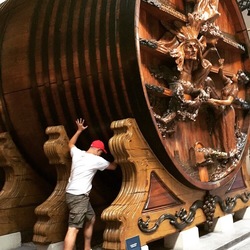
Wow. So different. Can't figure out the descriptors because this is so left field. Nonetheless it's amazing. It's apparently a unicorn around here, was the last one available in the province. Ten years old. Beast. #messi — 9 years ago
Shafer Vineyards
Hillside Select Stags Leap District Cabernet Sauvignon 2004
Needless to say, we slayed some dragons tonight. Let the birthday week continue!
This was my wine of the night. Thanks to Joe for bringing this out. Oh. My. Goodness. Maybe it was due to drinking this after some '80s cabs, but this was like decadent milk chocolate and bacon fat. And it's 13yrs old! 😍 — 9 years ago


Maybach Family Vineyards
Materium Cabernet Sauvignon 2007

Huge progression from the old worlds that we just pivoted from. Lavish bouquet of opulent fruits and a touch of menthol and bacon fat. Palette is explosive. The winemaker has packed a quart into a pint pot. Palette consists of jam, nutmeg, black olives, toast, and a hint of truffles. A huge fruit-bomb that I suggest you pair with you wife, or significant other. Stay home and switch the cellphones to silent... — 10 years ago


You'll be done with the crutches in no time at all!
Earl Domaine Lupin
Cuvée du Pépé Roussette de Savoie Frangy Altesse 2014

2014 is a great vintage. Old vine Roussette, fat & acidic at the same time with all that smoky, stone fruit. Gimme that mushroom fondue! — 11 years ago
Alienor
Cote de Castelero Syrah 2009

My notes are for a bottle of 2009 Alienor Sauvignon Blanc.
Creamy fat on the palate and showing a bit mature (not old or tired!) this is still drinking very nicely. — 11 years ago

Rene Rostaing
Côte Blonde Côte-Rôtie Syrah 1998
The epitome of old-school Côte-Rôtie, the 1998 Rostaing offers up an ever-evolving kaleidoscope of aromas: smokey bacon fat and animal notes at first, followed by sweet violets and steeped blackberries. It's quite lean on the palate, with ultra-fine, well integrated tannins—a mark of maturity—underpinned by high acidity and gamey-green notes of dill and green peppercorn, olives, and cold, compost-laden springtime soils. — 11 years ago
Domaine J. A. Ferret
Tête de Cru Le Clos Pouilly-Fuissé Chardonnay 1992

This is terrific for a 21-year-old Pouilly-Fuisse (it's the Les Clos), surprisingly very youthful, great minerality and also that aged white burgundy "plumpness" without being fat and overripe, long finish, just a amazingly fine wine!! — 13 years ago
Severn G

Nose has dried grape vines, (old) neutral oak barrel, dried black cherry, dried garden soil, (cooled) grilled tomato, graphite mechanical pencil refills, old coffee grounds and very dry compost/soil.
Palate has dried cherries resurrected in bacon fat, several day old sliced fresh cherries, blend of moist/dry soil with medium tannins. Cork pulled for a slow ox. for ~6h, then decanted ~1h. Picking up some since decanting, but still not moving the needle much. Likely great 5+ years ago, acceptable this evening.
Paired to a local pig, grilled pork chops from our favorite just over the border farmer (Highland Farm, Old Chatham, NY). Courtney only raises about six pigs every year, I'm overjoyed when we land some for our freezer, delicious factor 2x over just about anything else in the region.
(Pork was 93 points, if I had been more observant on internal temps would have been 95 points, still grilled to a wonderful medium.) — 6 years ago