End Of The Road Winery
Château Pontet-Canet
Pauillac Red Bordeaux Blend 2013

Pontet Canet tasting and dinner with Alfred Tesseron.
The 13 was a brutal tannin vintage when I tasted it at En Premier. The tannins are still bitty but, nothing like they were out of barrel.
The fruit in the 13 shows the difficulty in the vintage. They are duller and it’s really stands out from other vintages and not in a good way.
It’s lean and there is nothing that really draws you in. Fruits are; dark cherries, rhubarb, blackberries, some blueberries@and the strawberries show some ripeness the other do not. Lots of dry earth, dry stones, some herbs, dark withering florals, decent acidity and a uneventful dry finish.
Photos of; Clyde and Alfred at the bar, their Amphora style cement tanks they ferment part of each vintage now, road signs of the good neighbors they keep and Chateau Pontet Canet. — 7 years ago
Williams Selyem
Westside Road Neighbors Pinot Noir 2005

Anise, dark cherries, and a hint of forest floor. Well balanced and smooth from the first sip to the last. — 9 years ago
Opus One
Napa Valley Cabernet Sauvignon Blend 1999
another 2 bottles from the dinner that started with the Champy Docteur Leste from back at end of Jan 2017 — 10 years ago
Carmel Road
Monterey County Pinot Noir 2014

Friendly and representative cool climate Pinot. Bit of spice, short legs but foresty earthy goooood. — 10 years ago
World's End
Good Times, Bad Times Beckstoffer To Kalon Vineyard Cabernet Sauvignon 2009

Dard dark black and purple fruit true new work fruit notes of blackberry and ripe plum tar and graphite bitter sweet chocolate. Boom here it is! Monster!! — 10 years ago

Eminence Road Farm Winery
Elizabeth's Vineyard Dry Cabernet Franc 2013
Every kind of pepper imaginable on the nose: green, black, white, chili. Rich palate with fruit she an eye-opening herbal finish. Buy this now. — 11 years ago
Craggy Range
Te Muna Road Vineyard Sauvignon Blanc 2014

Most unique SB of the tasting lineup. #marlborough #sauvignonblanc #singlevineyard — 11 years ago

Beckstoffer Vineyard
World’s End Rebel Rebel Reserve Chardonnay 2013

Well made, clean, some pineappley fruit in the nose. The palate is enhanced by a bit of zippy/spritz. It doesn't give much at the moment aromatically. Textual fairly rich as the 14+ alc would lead one to expect. Not my normal drinking style but with trying and likely more restrained than many competitors. — 11 years ago

Herman Story
On The Road Grenache

Still amazed by this Herman Story On the Road Grenache. Second bottle a year apart and it still one of my favorite. Big, bold with plenty of acidity framing the fruit and giving it a liveliness and youth. Showing black fruit, oak, licorice and a bit of stone. New world done right — 12 years ago
Anthony Road/Fox Run/Red Newt
Tierce Dry Riesling

The 2008. Lime, slate and floral. Awesome backbone of acid. Medium + length. Killer. — 13 years ago
Jolie-Laide Wines
Fanucchi Wood Road Vineyard Trousseau Gris


Paul T, Missing My Beautiful Wife 24/7
Trade you a SQN for your clorox!World's End
Crossfire Beckstoffer Missouri Hopper Vineyard Cabernet Sauvignon 2010

Alas, a final hurrah in which to say, “Fare thee well, Del Frisco’s Grille!”
.
As for the wine itself, really delicious and seductively powerful with loads of potential for the coming years. A bit more feminine than the To Kalon, the MH has some finesse and sensual elegance that makes it less of a Lamborghini and more of a Ferrari. Lots of licorice, plum, blackberry, and cassis. I had the waitress pop the cork and pour me a glass for my steak, but I stopped at one glass. I’ll be taking this selection home to see how it evolves over the next day (or two).
.
EDIT: Day two and this wine is on fire 🔥So delicious. Much more balanced; it’s like it knows its own identity now. — 8 years ago

Brethren of the Road
Arroyo Seco Gewürztraminer

2016 from Winc — 10 years ago
Château Cos d'Estournel
Saint-Estèphe Red Bordeaux Blend 2001

Initially showing some oak and grip, but this settled into a cedar-y, spicy, elegant wine. Initially lagging behind the '01 La Mission, the intensity and integration built with time and air. By the end of the night, it was neck in neck. Great wine that will improve with another few years. — 10 years ago
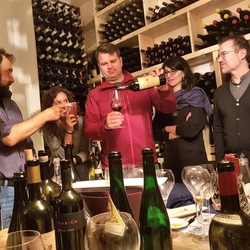

Neyers
Roberts Road Pinot Noir 2015
Darker fruits than the RR. Concentrated blackberries, dark cherries, creamy black raspberries, raspberries, dark crushed minerals, big chalk, touch of clove, Asian spice, perfumed dry red and pink florals. Nice acidity and length. Finish round with big spice and candied ripe fruit. — 10 years ago
J. Lohr
Tower Road Paso Robles Petite Sirah 2010

Pulled from the wine fridge and enjoyed this with fresh Salmon.
Very berry on the palate but not jammy.
Well rounded smoooth finish with barely a hint of tannin. Wonderful! — 11 years ago
Craggy Range
Te Muna Road Single Vineyard Pinot Noir 2011
Black cherry, raspberry notes. Fair amount of acidity. Paired well with baked salmon. — 11 years ago
Château Mouton Rothschild
Pauillac Red Bordeaux Blend 1989

Open up the bottle for about an hour before decanted for another half an hour before we pour the first glass. We were advised to drink it rather quickly once the wine is in the glass. Deep purple with browning in the glass. Aroma of tobacco, black tea, leather, and charred oak on the nose. Well rounded, complex, smooth and yet intense on the palate. Tanning is mellow. The finish seemed never end. The tiny drawback is that it seems to past its prime a bit. Overall an elegant wine. — 11 years ago
Mullan Road Cellars
Columbia Valley Red Blend 2012
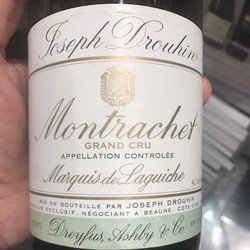

What. Fantastic wine and a prime example as to why WA state is surging with new recognition as the next great thing after OR foursome CA. Integrated with balance and complexity with a great nose and mouthfeel reminiscent of much older wines. I'm a buyer. — 11 years ago
Dominus Estate
Dominus Napa Valley Cabernet Sauvignon Blend 2009

Over the next 6 days of our road trip we will be drinking 6 top napa wines from 2009. This one's nose and perfume explode from the bottle. Fragrant in the mouth. Excellent. — 12 years ago
Produttori del Barbaresco
Barbaresco Nebbiolo

Wine blogger doxologywine.com; Freelance Sommelier (Court of Master Sommeliers) Doxology Wine Consulting
2008. Dried cherry, black tea, dried mushroom and rose, prosciutto. Minerality is reminiscent of standing on a dry, dusty dirt road. Only criticism is that it falls off in the mid palate, but finishes with a nice gamey note. — 12 years ago
River Road Vineyards
Reserve Russian River Valley Chardonnay 2018

One of my wife's favorites...medium oak, buttery, and she says mineral/fruit — 7 years ago
River Road Vineyards
Un-Oaked Sonoma County Chardonnay 2017
At Total Wine tasting 1/19 - sweet, but with a little acid just at the end. Very drinkable, pulls at my tongue, top wine of the tasting — 8 years ago
Château Brane-Cantenac
Grand Cru Classé en 1855 Margaux Red Bordeaux Blend 2005
I have a six-pack of this 05. I thought after 10 years in bottle, it would be interesting to check in on its evolution. While tasty, I’ll wait another 8-10 to open another. Even after 2-3 hours in the decanter, it’s still a very young adolescent. On the nose, slightly sour blackberries & dark cherries, dark currants, baked black plum, haunting blue fruits, anise, whiff of spice, steeped tea, dry stones, dry crushed rocks with dry top soil, caramel, vanilla with fresh & dry red florals. The body is thick & full. Tannins are starting to round out. It’s velvety on the palate. The fruits are; bright, fresh & ripe and really show the greatness of the 05 vintage. Dark currants, blackberries, dark cherries, baked black plum, haunting blue fruits, baked strawberries, cherries, raspberries on the long set, dark spice, clay & loamy dry top soil with crushed rocks, dry stones, cigar with ash, graphite, dry stems, slight herbaceous character, mint, used leather, clove, caramel, vanilla, fresh & dry red florals with violets. The round acidity is about perfect. The structure and length are still strong. The balance is in harmony. As for the long finish, it’s lush, ruby, rich and well polished. Photos of; Chateau Brane Cantenac, large wood vats, Henri Lurton and Estate vines. Producer notes and history...Chateau Brane Cantenac began in the early 17th century. At the time, the estate was known as Domaine Guilhem Hosten. Even that far back, wine was produced from the property. In fact, the wine was so highly regarded it was one of the more expensive wines in Bordeaux. It sold for almost as much money as Brane Mouton. This is interesting because of who went on to buy the vineyard in the 1800’s. The Baron of Brane, also known as “Napoleon of the Vineyards”, purchased the Chateau in 1833. At the time of the sale, the estate was called Chateau Gorce-Guy. To get the funds needed to purchase the Margaux vineyard, the Baron sold what is now called Mouton Rothschild, which was at the time of the sale, known as Chateau Brane-Mouton. Not such a good move with hundreds of years in hindsight! In 1838, the Baron renamed property taking his name and the name of the sector where the vineyards were located and called it Chateau Brane Cantenac. The Chateau later passed to the Roy family, who were well-known in the Margaux appellation in those days, as they owned Chateau d’issan. Moving ahead to 1920, the Societe des Grands Crus de France, a group of merchants and growers that owned several chateaux located in the Medoc including; Chateau Margaux, Chateau Giscours, and Chateau Lagrange in St. Julien, purchased Chateau Brane Cantenac. Five years later, M. Recapet and his son-in-law, François Lurton, took over Brane Cantenac along with Chateau Margaux. Lucien Lurton (the son of François Lurton) inherited Brane Cantenac in 1956. Today, the estate is still in the hands of the Lurton family. Brane Cantenac is owned and run by Henri Lurton. After being given the responsibility of managing Brane Cantenac, it was under the direction of Henri Lurton that large portions of the vineyard were replanted. Vine densities were increased, the drainage systems were improved and the plantings were also, slowly changed. The vineyard of Brane Cantenac is planted to 55% Cabernet Sauvignon, 40% Merlot, 4.5% Cabernet Franc and .5% Carmenere. Carmenere was used for the first time in the 2011 vintage. The only other Chateau I know that still uses Carmenere is Clerc Milon. The 75 hectare Left Bank vineyard of Brane Cantenac is essentially unchanged since it earned Second Growth status in the 1855 Classification. At least that is the case with the 45 hectares used to produce the Grand Vin of Brane Cantenac. Those 45 hectares are planted surrounding the Chateau. Those vines are located just in front of the Cantenac plateau and are the best terroir that Brane Cantenac owns. They have other parcels, which are further inland and much of those grapes are placed into their second wine, Le Baron de Brane. Those additional hectares can be divided into 3 main sections. Behind the Chateau, they have 15 hectares of vines on gravel and sand, 10 hectares across the road with sand, gravel and iron and a 13 hectare parcel with gravel called Notton, which is used for their second wine. The vineyard is planted to a vine density that ranges from 6,666 vines per hectare on the plateau and up to 8,000 vines per hectare for the vines located behind chateau, in their sandier soils. The higher levels of vine density are always found in the newer plantings. The terroir of Brane Cantenac consists of deep gravel, sand and clay soil. Experiments in the vineyards are currently looking at becoming more organic in their vineyard management. Today, more than 25% of Brane Cantenac is farmed using organic farming techniques. It is expected that over time, the amount of hectares farmed with organic methods will be increased. Brane Cantenac has gone through 2 relatively recent modernization’s in 1999, when they added began adding the first of their smaller vats to allow for parcel by parcel vinification and then again in 2015 when they completed a much more complete renovation of their cellars and vat rooms. While Brane Cantenac is a traditional producer, they are no stranger to technology as they were one of the first estates to embrace optical grape sorting machines. In very wet vintages, they can also use reverse osmosis. To produce the wine of Chateau Brane Cantenac, the wine is vinified in a combination of temperature controlled, traditional, 22 oak vats, 18 concrete tanks and 20 stainless steel vats that vary in size from 40 hectoliters all the way up to 200 hectoliters, which allows for parcel by parcel vinification. 40% of the fermentation takes place in the oak vats. The oldest vines are vinified in vats that are selected to allow for separate parcel by parcel vinification. The younger vines are vinified more often together in the same vats. However, the Carmenere is entirely micro-vinified, meaning that those grapes were completely vinified in barrel, using micro-vinification techniques. This can also happen because the amount of grapes produced is so small. Some vats can be co-inoculated, meaning they go through alcoholic fermentation and malolactic fermentation simultaneously. At Chateau Brane Cantenac, malolactic fermentation takes place in a combination of French oak tanks and barrels. The wine of Brane Cantenac is aged in an average of 60% new, French oak barrels for 18 months before bottling. The initial 2 months of aging is done with the wine on its lees, which adds more depth to the wine. There second wine is Le Baron de Brane. Le Baron de Brane is not new. In fact, previously, the second wine went under the name of Chateau Notton, which took its name from one of the main parcels where the grapes were planted. During the late 1950’s and into the 1960’s, having a second wine was important as the estate declassified 3 vintages, due to extremely poor, weather conditions in 1956, 1960 and 1963. Production of Chateau Brane Cantenac is about 11,000 cases per year. — 9 years ago


Felton Road
Cornish Point Pinot Noir 2009

Cobb
Joy Road Vineyard Pinot Noir 2008

Definitely among my favorite California Pinots these days. Lithe, juicy, and all sour cherry raspberry goodness with a side of citrus snap. — 12 years ago

Wind Gap Wines
Fannucchi-Wood Road Vineyard Trousseau Gris 2013

Sommelier, International Wine Guild; Balistreri Vineyard; Sales, Joy Wine and Spirits
Bright acidity from the concrete egg fermentation. The flavors are approachable even though it is a grape most people haven’t heard of. Fresh pineapple and vanilla. People would love it if they could give it a chance. — 12 years ago
Villa Creek Cellars
End of the Road High Road James Berry Vineyard Grenache Blend 2007
In 2010, Wine Spectator crowned James Berry's "Saxum" their Wine of the Year. The $75 bottle now is sold for $300 or more at auctions. However James Berry also sells his grapes to other wineries. Every year Villa Creek creates a James Berry Vineyard "High Road", but for the 2007 vintage they keep a selection in oak barrels for an extra 2 years. The result is the High Road "End of the Road". The aging and limited release brings a bottle to $100 (for non club members), but I now consider this a wine in my top 10 favorites. Think full bodied California Cabernet fruit blast meets elegant balanced French red. The sip glides over your tongue and waltzes with your taste buds. Caution, this bottle packs a subtle punch with 17% alcohol ... So share or call a cab! Wine Spectator rates it a 93. I would go higher! Cheers! — 13 years ago
Kristin the Wine Girl
Dusty earthy cherries and herbal stemmy viney soft tannins. Has the sensation of crushed mulling spices in dark tea. Soft Xmas in April style Pinot. A great value Pinot! $22 at Uncorked Hermosa Beach. — 6 years ago