Territory Cellars
94574
Rutherford Sauvignon Blanc

2012 Rutherford - nice example of a great SB vineyard in the heart of CS territory. Rangpur lime, vanillin , kiss of herb - fresh & dried. Nice length no screech or burn. — 11 years ago
Maculan
Torcolato Breganze Vespaiolo 2009

New territory for me with lemon panna cotta.@thepigchicago. . — 12 years ago
Syncline
Underwood Mountain Vineyard Grüner Veltliner 2012

Best domestic Grüner I've ever had. Lots of green, ripe citrus and orchard fruits, lees influence, and varietal savories (lentil, radish, parsnip, pea purée). 12.7% alcohol puts this in ripe, clean federspiel territory. Similar to Prager or FX in style. There's something special in the Columbia Gorge, I think. Anyone know if this is loess over decomposed basalt in the vineyard? — 11 years ago

Čotar
Cabernet Sauvignon

This is Cotar's cabernet sauvignon, wine from Kras (Carso italian & Karst german) special territory in Slovenia,. Soil in Kras is red and makes special flavour to wine . Good wine, well combined with prosciutto and red meat — 11 years ago
Dormilona
Sauvignon Blanc
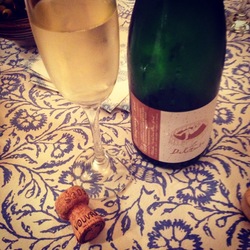
Re-rating, loving this more and more. Scholium territory Sauv Blanc. — 11 years ago
Domaine Guion
Cuvée Domaine Bourgueil Cabernet Franc

Venturing into French territory. Very new to me. Oaky & Nutty with Blackberry and Vanilla. — 13 years ago
Sequana
Dutton Ranch Pinot Noir 2010

Love the territory. Beautiful fruit. — 11 years ago
Domaine Guiberteau
Les Motelles Saumur Cabernet Franc 2011
Soft velvet mineral cut sugar free cherry pie. This totally reaffirms my liking of Loire red and firmly establishes Saumur is white wine territory. My apologies for blowing the spot on the free flowing sheets of Chenin acid. This is totally enjoyable for sipping with nothing else in the way of your perception...or to ironically balance out the glass of Saumur blanc in your other hand. — 11 years ago
Domaine Vincent Prunier
Meursault Chardonnay 2008
Located in Cote de Beaune, south of Volnay and north of Puligny Montrachet. Meursault ("Murr-so") has historically been Burgundy's center for white wine production. In fact, nearly all of the 2.5 million bottles produced from 440 ha (1,090 acres) are whites. The soil is a mixture of marl and chalk and is perfectly suited to the production of chardonnay. Meursault wines are known for aromas of hazelnuts, honey and vanilla for its aromas and creamy, almost olive oilllike texture. There are no grand crus in Meursault, though Les Perrières, Les Genevrières and Les Charmes produce remarkable wines. Further, some of the most well-known vineyards of Meursault such as Narvaux and Limozin are not premier cru but Villages-classified vineyards. Recent top vintages include 2008, 2007, 2005, 2002, 1999, 1996, 1993, 1990.
With 437ha. of vineyards dedicated to Villages wine or Premier Cru, Meursault has the largest area permitted to be planted in white wine in the Cote-d'Or. Furthermore, despite the fact that the village lacks even one grand cru, Meursault has historically been Burgundy's center for white wine production, in the past even more so than Puligny-Montrachet or Chassagne-Montrachet. While much of those two villages had in the past been planted to red grapes, Meursault has always been white wine territory. In fact, the modern day vineyard of Les Combettes in Puligny-Montrachet, which forms a continuous chain with the premier crus of Meursault, was once considered part of Meursault and not Puligny, where the many nearby vineyards produced red wine. There are several important factors that determine the reputation of Meursault. Primarily, the soil throughout most of Meursault is perfectly suited to the production of chardonnay; it is a mixture of marl and chalk, that when combined with a largely east or southeast exposure creates healthy grapes that are full of character. Another factor correlates to geology, though in a very different way. Meursault's high water table allows its residents to carve deep, cold cellars "perfect for the production of wine" into the chalky, stony soil. So, while large negociants from Beaune dominated the production and marketing of Burgundy throughout time, Meursault remained a wine of its own citizens. Contributing to this, since red wine has been more prized throughout time, these same negociants looked elsewhere for sources because the wine of Meursault has always been white.
What makes the wine so special? The most common descriptors attached to Meursault are hazelnuts, honey and vanilla for its aromas and creamy for its texture. However, this simplifies things quite a bit. In most cases, Meursault despite an almost olive-oil texture is countered by a precise mineral character, stoniness and a more refined overall palate than, for instance, Chassagne-Montrachet. It's the unique stony/mineral character that often gets lost when tasting Meursault, as many concentrate on the ripe, hedonistic primary flavors and aromas. It's the bipolarity of the wine, the interplay of both factors, that makes Meursault one of the most sought after white wines in the world. As mentioned above, there are no grand crus in Meursault, though many would argue that Perrieres, Genevrieres and Charmes can attain these lofty heights in the hands of the best producers. Further, some of the most well-known vineyards of Meursault such as Narvaux and Limozin are not premier cru but Villages-classified vineyards, though again, the best examples are clearly of higher quality. source: http://www.burgundywinecompany.com/wines/display.php?subregion=Meursault — 12 years ago
Keith Levenberg
I've been hesitant to open this because the Tre Stelle was so challenging and this is supposedly the more structured of the two, but I shouldn't have been, as this is a wonderful and phenomenally easy-to-drink wine, about as friendly as young nebbiolo ever gets. If it is indeed more tannic than the Tre Stelle, that is only the case on paper as the structure is smoothed over by rich, very polished fruit that still has the gloss of youthfulness but whose flavors are well past the primary into savory and earthy territory with a sticky grip. It opens with a dazzlingly complex aromatic punch of herbs and a succulent meatiness, which quiets down soon enough but the wine never shuts down. The fruit is in crimson tones, plummy at first and then more towards apple skin hours later as it backs down from that initial generosity, but throughout the bottle it is full and plump, finishing with stony earth. I'm slightly tempted to call it autumnal just on account of the complexion but that doesn't seem to work because there is a very clear sense of freshness here. No leatheriness or other badges of oxidative aging that surface fairly often even in nebbiolos that I *like*: this bottle captured everything in pristine condition, making an exceptionally delicious wine with a robust inner core but a flawless veneer with no rough edges, brimming with generous, richly constituted nebbiolo goodness. — 10 years ago